Blog post written by:
Patricia Silva and Khalil Teber
On the morning of the 18th of July, around 30 people gathered in a warm room on the first floor of the Faculty of Science of the Eötvös Loránd University (ELTE) in Budapest, Hungary. Amongst the sound of nervous fidgeting and shy smiles, excitement was in the air. And thus started the COST Action DAMOCLES Training School on Dynamical Modelling of Compound Events.
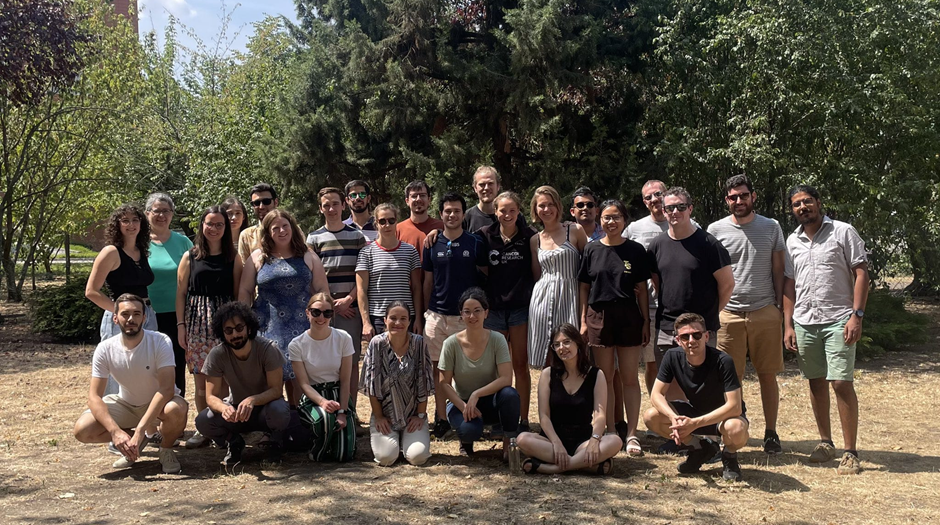
We were first introduced to the faculty and the beautiful city of Budapest, with Rita Pongracz as our host. Then, the organisers made sure that this room full of strangers would not stay as such. Everyone was quick on their feet for the first ice-breaker of the week: the challenge was to find five common characteristics between five random group members. Groups found interesting similarities, including music bands, physical resemblance, food tastes, and a weirdly specific trip to Florida that year. During the morning, Fiachra O’Loughlin and Benjamin Poschlod further introduced us to the DAMOCLES Cost Action and their first Training School on Statistical Modelling of Compound Events (about which you can read here), and Emanuele Bevacqua gave a concise yet comprehensive overview of the reason we’re all here: compound weather and climate events.
Lunch was served, a very pleasant mix of vegan options and traditional Hungarian flavours, and the group was now in full networking mode. This was complemented by another ice-breaker later on, where random groups of two were formed, and each would have to give an elevator pitch about their companion. Suffice to say, we got to know our colleagues on a deeper level (maybe even deeper than we’d like sometimes). Finally, student projects and mentors were introduced, working groups finally met, and group projects were kicked off.
From here onwards, the format was simple. We had lectures every morning, ranging from (dynamical) modelling basics to sub-seasonal predictions, from impacts on vegetation to energy and insurance outlooks. In the afternoons, the four working groups met to work on their respective projects, hoping to find some interesting preliminary results that could lead, not only to a better understanding of compound events and their modelling, but possibly to a collaboration that would last beyond the Training School. Spoiler alert: we were quite successful in both.
The group projects covered different topics: counterfactual statistical analysis of tropical cyclone impacts, compound floods in the pre-alpine region in central Europe, impacts of compound events on vegetation productivity in Europe, and the influence of climate variability modes on compound wind and precipitation events in the Northern Hemisphere. Each group had to organise and use the afternoons efficiently to make sense of the data, write the code, and discuss their approach. The workload was challenging, but it was definitely a great formative experience for all participants.
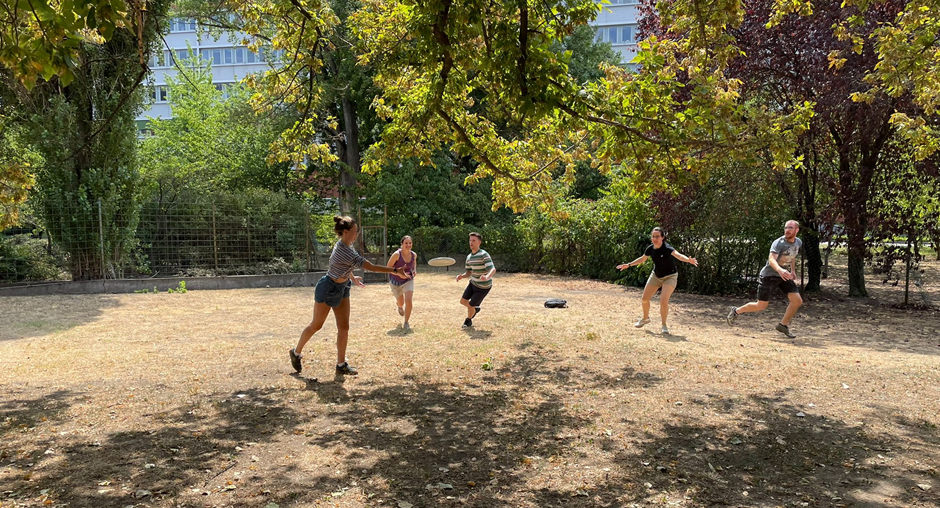
The school ran for two weeks from 9 to 5. Or so we were told. In reality, we always had activities together beyond the Training School, as people quickly gathered to play during the breaks (there was an awful lot of badminton and frisbee), drinks in the evenings (the ruin bars were fun), and to explore the city. And, of course, it could not be more appropriate to study compound events than in the middle of a scorching heatwave. For this reason, and for this reason only, the baths and the Danube beach were almost a daily activity.