
By Emanuele Bevacqua, Helmholtz Centre for Environmental Research, Wiebke Jäger, Vrije Universiteit Amsterdam, Zengchao Hao, Beijing Normal University, and Pauline Rivoire, University of Lausanne.
The EGU general assembly is always a great opportunity to meet colleagues and friends who travel from all over Europe and the globe to Vienna to share their science and insights. This year’s edition was again amazing, with more than 18’000 people on site. Among the myriad sessions, the compound weather and climate events session took place on Friday, 19th April, for a last intense and exciting conference day. With these lines, we wanted to take you with us through our experience as conveners of this session.
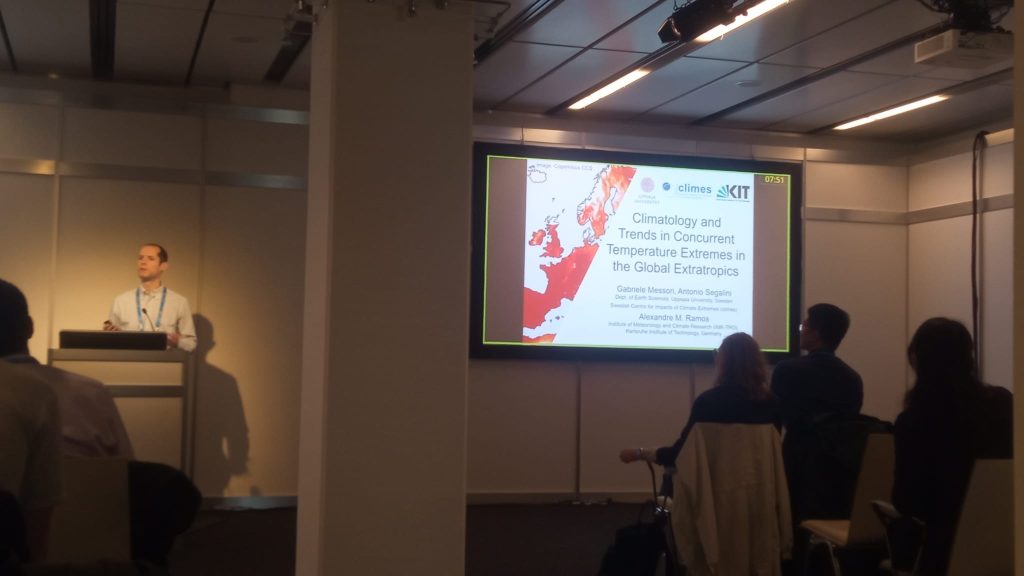
Photo: Gabriele Messori’s contribution to the compound weather and climate events session.
As conveners, we were thrilled to witness the session’s success, marked by great participation and stimulating discussions. Let’s talk numbers! With 30 talks, 21 on-site posters, and 2 virtual posters, the session covered a broad spectrum of topics, ranging from the attribution of compound events to human-induced climate change to the exploration of very extreme events via novel approaches, projections, impacts, and applications related to machine learning and seasonal forecast. This also included the presentation of our invited speaker, Kai Kornhuber, on pathways towards usable compound events research. Such a variety of topics covering different types of compound extremes contributed to very engaging discussions among experts of different subdisciplines, both during the session itself and while grabbing a coffee during breaks ☕. Notably, we were delighted to welcome 35 early-career scientists presenting their research! Including participants of the last Como training school on the statistical modelling of compound events.
Given a large number of abstracts, we clustered them into three categories, namely multivariate events, spatially compounding events, and temporally compounding and preconditioned events. We then had to assign OSPP judges, at least three per poster, to have an impartial grading of the poster. As we await the outcome of the awards (it should take less than two months!), we extend our “Good luck!” to all candidates. 🤞
Although the session was on Friday, that didn’t seem to affect engagement and the good vibes. Maybe that was also thanks to free chocolates for those brave minds (😄) asking questions – an idea taken from the multi-risk session 😁. Indeed, we had great participation in the final Poster slot, both from presenters of the session and visitors, which led to exciting discussions. Once again, this was fueled by the many highly motivated early career scientists and candidates for the OSPP award!
And, of course, there was also ample time to network and socialize! As is tradition, we organized a big dinner together with the multi-risk community on the evening before the session. A great way to spend some time and chat with old friends and colleagues as well as meet new people from the communities!
We would like to reiterate our commitment to promoting young researchers through the CompoundNet community! If you’re an early career researcher (ECR) looking to make your research more visible and connect with a supportive network, we invite you to join us. You can even feature as an ECR of the month! Interested? Fill out this form to get started!
Finally, we would like to thank all the speakers, all the posters’ presenters, the OSPP judges, our technical assistant Samira, and the many researchers who attended the session. The atmosphere was kind and respectful, and it was the very attentive audience that contributed to the success of this session. We hope to continue seeing all of you around in the next years, so as to continue boosting the participation and enthusiasm within the compound event community! Thank you – see you next year! 🚀
Post edited by Pauline Rivoire. Photo credits: EGU2024 (top image), Andreia Ribeiro (photo of Gabriele Messori’s presentation).
